

Empower Your Scrolling Habits with Cognizance
Examining a petri dish of social media users to better understand how social media controls our online worlds

Introduction
What another interesting week on the internet, huh?
If you spend most of your time on TikTok, especially on the side where Black creators create, then you will have probably seen the outrage that has stemmed from user SlimKim, who bravely proclaimed that she loves being skinny, and that it is something that she (in her own words) “thinks about all of the time.”
I would have a link to this video in my usual fashion, but the video has been removed by TikTok as users were reporting the video for “hate speech and hateful behaviors". EDIT: The video is back up! I will have it below, but I will be keeping the text that I originally typed as that was the reality that I was living in when I originally typed that up!
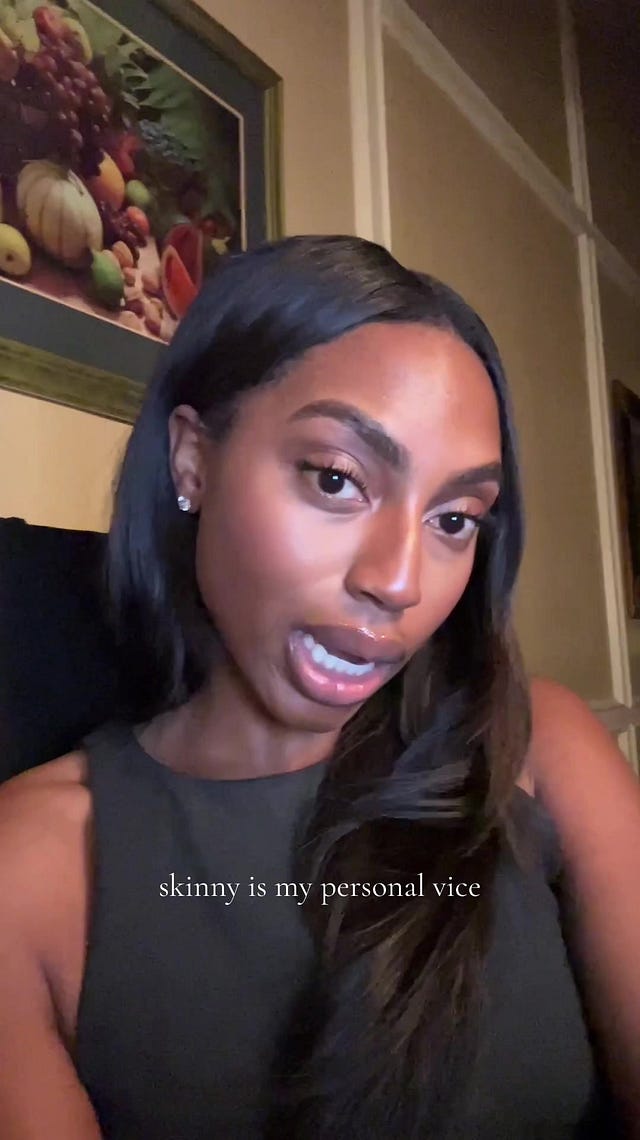

Now, this side of the internet is divided into two camps, those who believe that SlimKim is allowed to love her skinny body, and those who believe that she should stay quiet on it for numerous reasons. I have seen users saying that SlimKim’s comments contribute to the “alt-right pipeline” for women, that her comments show how we’re “cooked as a society”, that she is fatphobic due to her video, highlight her lack of “self-love” for herself since she only likes herself skinny and fears being anything but skinny, that she clearly has an eating disorder due to her statements, and proof of how we are regressing back to the old times of society when diversity of skin tone and body type weren’t praised or upheld to any positive beauty standards.
It has been such an interesting display for me, as a curious internet explorer, to watch as the algorithm amplifies the videos about her and spreads them en masse, causing chaos on TikTok in real time.
For this piece, I want to follow this very topical line of thought as toxicity continues to prevail in spaces, communities, and posts that claim to help us all to come to conclusions about our messy, messy society.
The Algorithmic Trap—Your Custom Made Echo Chamber
In today’s fast paced social media society, it is fascinating to watch as people interact with social media as it was intended to be interacted with, while simultaneously watching as people think that they are fighting against the algorithmic overlords that engineer succulent programs to keep us glued to their creations.
Let’s talk this idea through with the SlimKim situation as our example.
When this controversy was at its peak, people were going into their separate camps to either dunk-on or defend Kim, with some folks meeting in the middle to dunk-on or defend her on someone else’s turf. We have think pieces being made about the gross disgusting impact of her harmful words, and think pieces being made about how her words resonate positively and how there is no fault in her word choice.
The part that’s fascinating as someone who is on the outside of this situation and truly doesn’t care either way, is how everyone is convinced that their side has won. By leaving a brash video or comment defending or demeaning Kim’s words, you have won the fight, and if you have other people on your side then you have won the battle.
Although this controversy in itself doesn’t matter in the grand scheme of things (because let’s be real, who cares if someone prefers to be skinny or not, and who cares if someone does care if someone prefers to be skinny or not), it does matter when we look at this common pattern of how social media users are utilizing today’s internet and how that pattern is affecting us as humans on a global scale.
We are starting to see online users craft audiences that are so entangled with one another that it becomes a giant hivemind of groupthink, and it’s so frustrating to watch as someone who enjoyed the older versions of the internet that allowed for the expression of the creative self as an individual. Now, it just feels like these online spaces that could be used to build community are being used to create a place/space that is all uniquely yours. A place solely meant to represent you and only you, the viewer, not the creator.
This is not a community. This is an echo chamber.
To explain this even further, here’s what Dr. Kurt Braddock, assistant professor of public communication at American University, had to say about the algorithms in Forbes:
"The algorithms used to determine which content people see necessarily puts people in their own echo chambers where they are only exposed to things they agree with, which basically creates distinct 'sides' on issues," warned Braddock.
"The platforms are financially incentivized to do this since people are more inclined to engage with material they agree with, which makes it easier to earn advertising dollars by placing that content in front of their users that they'll look at and click."
As I expressed in a prior piece, when you work social media the way that it works you, you can truly craft a feed that feels like it was made for you. You can create a feed that perfectly articulates your dreams, wishes, and desires in one place. In a way, you begin to take ownership of the social media app or interface, and maybe begin to believe that it is not only yours, but it is an extension of you.
Coming from that standpoint, I can understand the anger from those who realized that SlimKim’s skinny sentiments were on their well-crafted feed (and thus, their app), and felt the need to lash out (or defend) in order to restore the balance and return their app to the addictive dopamine center that it once was.
However, the issue is this constant de-selfing of creators in an effort to maintain echo chambers on apps that are being crafted for capitalistic endeavors, not for our enjoyment as viewers.
I, I, I. Me, Me, Me. An Age of Angry & Entitled Social Media Users.
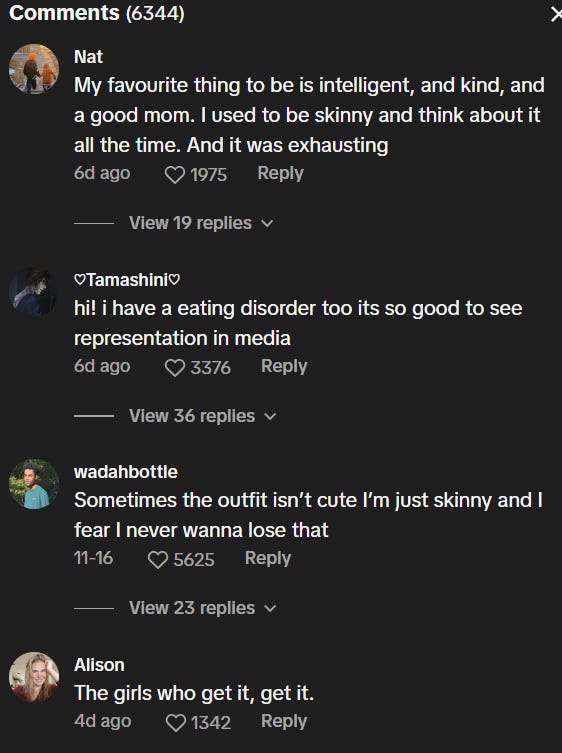
This is a sentiment that I have been examining for the past few years as I see more and more people attacking online creators for not fitting within their desired expression of reality. I plan to speak more exhaustively on this topic in a separate post dedicated to this topic, but for now, I want to examine this thought briefly in the context of the SlimKim controversy.
The invention of the “Influencer” and its proximity to us normal folk has given us a new definition of celebrity that we have never truly experienced before as humans. Now, we can converse directly with those who have riches, fame, and notoriety. The worse part is that if someone creates content that affects you negatively and you wish to take it out on them, technically, you could. You could sling all sorts of vile words and threats to this person who has affected you, and in many cases you could even cause a response to happen either via the person you’re trying to verbally harm, or even a response from their associates. This allows you this direct line of communication to harm others that can even result in a direct indication that you were successful in your pursuit to harm others with said words.
Unlike the celebrity icons of the past, it is a feedback loop that begins with your hatred and ends in a response that confirms the effectiveness of the harm you’ve caused, such as with a comment response, a block, or even an entire video response.
To narrow the scope back to the SlimKim incident, I am aware that weight can be a touchy societal topic. From experiencing the end of the heroin chic era of the 90s to the body positivity movements of the 2010s, it would be naive of me to pretend that body composition would ever be a light topic in any capacity. However, the problem occurs when we place a magnifying glass on the content that caused this uproar.
In SlimKim’s defense, I will say that she made content that was truly representative of herself and her experience. She stated that being skinny is something that she is obsessed with, something that she likes to be, and something that she fears losing. This piece of content wasn’t geared towards anyone outside of herself, it wasn’t said in a mean or snarky manner, it was just a true and genuine account of someone who really, truly, loves being skinny. It is also worth noting that her username is “SlimKim” which we can infer would mean that she truly values being skinny, especially in this context.
But when we combine the knowledge of how the addictive social media algorithms work, along with the ownership that people take when it comes to the media that comes across their feeds, added with the extra layer of sensitivity that comes with speaking about topics surrounding weight, and not to mention the intersectional aspect due to SlimKim being a Black woman, we end up with a whole mess that is impossible to untangle due to the rapid nature of social media. Adding in how reactionary social media users have become, a storm of hatred was bound to occur despite her efforts to highlight that the reason she said what she said was because of what she enjoys.
Realistically speaking, this is quite a complex problem that can’t be solved within today’s era of social media because the fast-paced nature of it all is the name of the game, and we can’t possibly understand both ourselves and others on a deeper level in the time it takes to scroll through content that evokes seven layers of emotions within us.
There is no time or space for empathy. There is no time or space for compassion, or deeper understanding and connection. There isn’t even time or space to even ponder the question, “How does this content truly affect my personal life in the grand scheme of things?” and then create a plan to begin the work that would fundamentally remove or heal this problem that this content is causing. Under the thumb of capitalistic social media endeavors, there is no time for pondering. There is only time for knee-jerk reactions and surface level feelings.
Don’t Hate the Player, Hate the Game
I don’t have the data for the statement that I’m about to make so this will purely be an opinion from me, but if I had to give it a guess, I’d say that 95% of chronic social media users do not understand the way that these apps work to feed on and harness your love and hatred for things to capitalize on your attention. I make this assumption based on how angrily users react when they see content that they don’t agree with, don’t resonate with, and even don’t relate to.
I’ve watched users on social media proclaim things like “don’t put this on my feed”, or “I don’t wanna see this shit wtf”, or even threats and insults to the creator of the content or those who dare to enjoy it simply because the content exists on their feed. The part that gets me, is that users who engage in this type of behavior are too trapped in the anger of their disrupted dopamine rush and lack of education on how social media is engineered that they don’t even realize that their feed looks the way it does because of their own actions. Their own hatred for this type of content is exactly why it continues to get recommended to them.
Devon Dundee states in his blog post:
The algorithm only cares about engagement, not the quality of the experience that users are having. Sure, it’ll show me things that are genuinely interesting to me. But it’ll also show me posts that it knows will get under my skin in order to get me respond, to post back, to spend more time on the service so I can be shown more ads. The algorithm is optimized to do whatever it takes to keep me engaged as long as possible.
Whether you leave a hate comment or even a comment filled with love and support, you are fueling the algorithm. You are telling the algorithm that you enjoyed what you observed enough to engage it with one of the highest honors—a comment. Even if you did not leave a comment out of love, you are still telling the algorithm that what you viewed was worth being viewed by another person, and is something that you would most likely engage with if shown that sort of content again.
As a digital marketer, I have known this for years, and it always frustrates me when I see so many people engaging with social media in the exact way that it was meant to be used, all in an effort to make their lives (or rather, algorithms) better. In continuing this pattern, users are only getting fed more content that riles them up and makes them even more discontent with the current state of their feeds, thus making them more miserable overall.
As an early internet and social media adopter, I feel that there are ways to coexist with the rampant algorithms that attempt to overtake our lives and influence our spending power. This will be yet another long ongoing conversation to be had especially since this only highlights one facet of social media’s control over us all. For now, I hope that as we step into the new year, you—whoever is reading this—can use this examination of the SlimKim situation to better understand how social media (yes, including Substack) feeds on your activity, and also how you can truly take control of your algorithms and your life despite being within this system.
Maybe you will even find ways to coexist with the algorithmic overlords to achieve your own goals. We will go more in depth on that another time.
Additional Reading:

How social media algorithms 'flatten' our culture by making decisions for us by NPR
How have social media algorithms changed the way we interact? by BBC
Are you only being told the things you want to hear? by Massachusetts Daily Collegian
From Nazi propaganda to Holocaust denial, social media is pushing hate on users: study by USA Today