

Utopia Lies in the Balance
And I fear we will never get there

Introduction
Here we are, post-election, post-new years, and post-super bowl, and one thing remains abundantly clear to me: we will all continue to be one another’s downfall in the grand scheme of “progress”.
It has been fascinating to watch think pieces and videos crop up about Kendrick Lamar’s halftime performance and observe the stark differences between those who are finding meaning in every millisecond of his performance, and those who believe that his performance simply isn’t adequate enough in the name of advancing Black folks and other POC in today’s grim America.
Typically, we ascribe such rigidity in beliefs and extremist ideals with those with right-leaning ideologies, but it has been interesting to watch those who identify as progressive, liberal, or left-leaning in general rip Lamar’s performance and his credibility as a change-maker to pieces simply because he’s wealthy and has maintained his wealth after his so-called “revolutionary” performance. Therefore, his efforts are null and void as he simply did not rebel hard enough to “truly” make a difference.
As the saying goes, I believe we have truly “lost the plot”, and in this piece I will be discussing the new plot that seems to be at play and how we could potentially course-correct ourselves back to an existence that continues to advance all of us no matter how long it takes to achieve extensive progress.
The Goody-Two-Shoes-ism of it All — Puritanism & Self-Righteousness
I think that by historically being on the right side of history, people of color, especially women of color, find it harder to allow individuals to just show up as they are without grossly criticizing them.
We’ve mastered the art of uplifting those who work to call out and highlight the racial injustices that continue to harm the Black community, and we’ve also worked hard to call out those who disrupt the Black community from within the Black community. But now, there is this increase in calling out those who are not up to par with the standards of perfection that seems to be set up as a reflection of if someone is “truly” a part of a movement or if someone “truly” cares about a cause. We’ve entered an era where we are all continuously having our rebellious “gangsta” tested by those who believe that they are the spokespeople for all of our progress.
I curiously watched Kendrick Lamar’s Superbowl performance live just in case he did something so outrageous that it got taken off the air (which ultimately did not happen), but I was happy to see clever symbolism and references that allowed him to make his revolutionary points whilst staying on air. The immediate references that I had caught were the American flag being divided, the all Black dance crew, Samuel Jackson playing “Uncle Sam”, and the reference to “The Revolution Will Not Be Televised” at the beginning of the performance. To me, it felt like Kendrick made his point, and made it well at that. I felt like he did what he could as a Black celebrity who was given this opportunity to perform on a stage viewed by a worldwide audience.
What happened next truly shocked me. Waking up the next day and seeing these opinions floating around that devalued his performance strictly because of his millionaire status (with many incorrectly calling him a billionaire to fit this narrative that his contributions are null and void due to his well-off status) was very shocking. Many critique that since his “revolutionary act” allowed him to keep his fame and riches in a world where the poor continue to struggle and the rich continue to prosper, it was simply not “revolutionary” enough and was nothing more than a “minstrel” dancing for the white man.
Considering that we still live in a world where rich Black folks are still subject to police brutality, I think it’s fair to have a bit of nuance and understand that Kendrick probably knows that his identity as a Black man takes precedent over his status of wealth, and that ultimately he can’t use the Super Bowl as a playground for his revolutionary concepts and ideas. He unfortunately, just like us “common folk”, has to combine his artistry and emotions with a tactfulness that allows his message to remain widespread and received by the world.
He could always make the same mistakes that he made during his Grammys performance in 2016 in which he performed a powerful piece that featured himself and his dance crew in chains and even a freestyle about Trayvon Martin. This performance, although powerful and blunt in its approach, has led to it being wiped from the internet, which is why I have linked a recap video from AJ+ as opposed to the actual performance. It is nearly impossible to find, and every time I find a video, I come back to it having disappeared shortly after.
I understand why an in-your-face approach is the most desired approach from onlookers, especially when we take into consideration the decrease in critical thinking skills, reading and comprehension skills, and even in patience. The blunter the message, the more disruption is caused, the easier it is to understand, and the sooner we reach salvation, right? But when it comes to matters involving art, it is simply not as cut-and-dry as throwing resistance into someone’s face and getting the outcome we desire.
We may have this perceived notion that a fierce and assertive approach is exactly what’s going to cure us of our societal ailments, but the reality is that such an aggressive approach is more likely to be taken down (like Kendrick Lamar’s 2016 Grammys performance) or cause the artist in question to have a harder time securing opportunities that would allow them to spread their messaging in the future.
On the same accord, I understand that it is only human nature that would cause tensions towards those who do not get-in-and-fit-in with these puritan standards. It only makes sense that the discontent that we all feel in today’s jacked-up whacked-up societal, political, economic, environmental, (and so on) climates is what’s causing us all to become more extreme both in our views about the government and about one another’s adherence to certain views or values. But when it comes to the fight for progress, it would benefit all of us to take a step back, take a breather, and recognize that none of us are perfect, let alone perfect revolutionaries.
Revolutionaries Don’t Take Vacations
When the holier-than-thou call the shots, there is no room for error, emotion, or ease. If you do not do something “perfectly” enough, then you simply haven’t done it at all.
Take for instance, the Black women and Starbucks boycott situation. As the election season came to a close and demographic stats and interviews were released, an uproar occurred as individuals on the internet began to parse through the information.
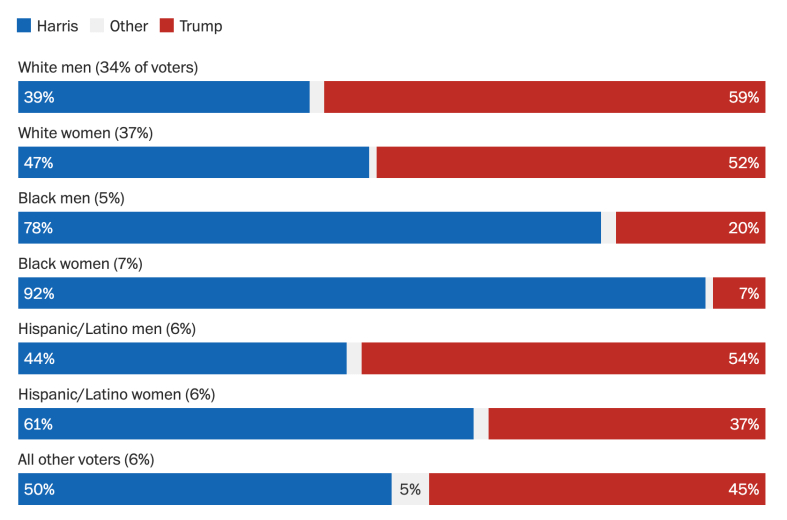
One particular graphic that caused an uproar online was the one above, which was widely shared and being touted as a screenshot showing the exact data for how everyone voted in the 2024 election. In the same timeframe, an article and several videos were released on social media that showed several Arab Americans detailing their reasons for choosing Trump in this election. To sum up the sentiment in many of these videos, it appears that this was primarily done to spite Democrats and out of their rationale that to them, Trump would do more for Palestinians and for Americans as a whole in comparison to anyone affiliated with the Biden-Harris platform.
Despite the graphic above actually being an exit poll from 22,966 randomly selected individuals across the country “conducted by Edison Research for the National Election Pool consortium of ABC News, CBS News, CNN and NBC News”, the internet took this idea that this was an exact depiction of how all Americans voted, and with the Arab American interviews fanning the flames, a new movement was birthed online: the 92% movement.
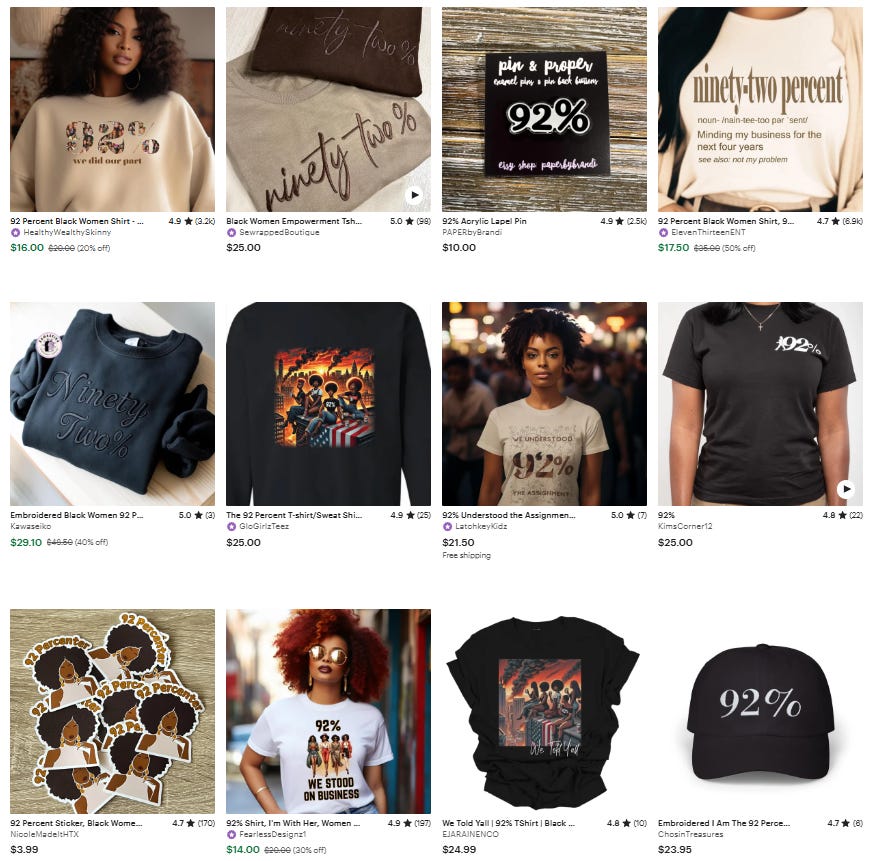
The 92% movement derives its namesake from the 92% of Black women in the exit poll who noted that they voted for Kamala. The movement is about allowing Black women to center themselves for the next four years (and even beyond that if they so choose) without feeling peer pressured to be a part of any movement or revolution that could cause harm or disrupt one’s peace. It encourages Black women to step back, recharge, and enjoy life without running into the fray to become a revolutionary again.
In addition to this sentiment being widely adopted on social media, there was also an uprising of Black women expressing discontent that other racial demographics did not show up in the name of progress the way that Black women collectively did. Due to this, many Black women decided that they would no longer boycott businesses like Starbucks, and many more would even choose to go as far as publicly supporting Starbucks in order to spite the Arab Americans who purposefully voted for Trump in an attempt to spite the Democratic party. This is due to the incorrect and widely held notion spreading on social media that states that Starbucks directly supports Israel, and thus supports the ongoing genocide of Palestinians.
Very soon after, there was a surge in new think pieces centered around chastising and reprimanding the Black women and Black men who had decided to renege on their commitment to boycotting businesses like Starbucks, and even more think pieces about how this caffeine riddled injustice now means that those individuals “never supported Palestine to begin with”, but not very many think pieces cropped up that gave grace to Black women and men’s anger and grief in this situation.
What makes it worse is that due to these belittling pieces, a new rhetoric began to spread in which Black folks began noting that they no longer cared if Palestine was “turned into a parking lot,” or they noted how they were sure that “oceanfront property” would be “beautiful” at this time of year, due to their invalidated anger alchemizing into a vitriolic hatred that made them too frustrated to continue to fight for a movement that they were becoming gatekept out of.
Social media (especially TikTok) moves very quickly, leaving us little time to give situations the nuance and consideration that they deserve. To this day, I haven’t seen any new ideas or thoughts regarding this situation, and it appears that everyone is rigidly in their camp of emotions with little capacity for further understanding and compassion.
I haven’t seen many trending think pieces that hold those accountable who have created a notion that both candidates carried the same risks and issues for the American people and the world at large. I haven’t seen a balanced think piece go viral that allows Black women and men to grieve and express their disappointment through the means of drinking their Starbucks coffee. I haven’t seen a widespread notion that expresses that maybe one small infraction—the size of a large cup of coffee perhaps—does not negate how much one truly cares about a cause or a societal issue, and that when one is ready and feeling better, they can jump right back into the fight just as they did prior, and that maybe this break will allow them to fight with a strength that they didn’t have before.
As someone who doesn’t drink Starbucks anyway due to me not enjoying their products or practices, I did wonder how I too would express my discontent and remove it from my nervous system. I opted for talking to my Black homegirls and also speaking in a post-election open-forum and aired out my grievances in safe spaces that held my anguish and did not invalidate how I felt (despite one moderator getting very close to doing so). It is only human to be so upset when you’re let down, and it feels even worse when it feels like the world—especially those who you were working hard to protect—has let you down too.
Being someone who cares about Palestine and who also feels the immense weight of disappointment about this election, I have to wonder: are we really basing the depth and extent of one’s care about a cause on… rebelliously drinking coffee? When we know good and well that drinking coffee is not how we got here as a society, is this really the hill that we feel we must die on to achieve progress as a people?
By being so rigid with these self-imposed rules of what it means to be a “proper” revolutionary, we lock people out of having the opportunity to even care about the matters at hand. We also disregard the reality that at the end of the day, we’re all human, and we should use that knowledge to find common ground rather than to discover “perfect revolutionaries” who will then be deemed worthy of credit for their efforts towards bettering the world, while tearing down everyone who doesn’t meet those unnecessarily rigid standards.
In a future piece, I will discuss more about the 92% movement, its progression from centering Blackness to developing into a space being widely criticized, and what the movement as a whole says about the immense visibility of Black pain and suffering and how Black individuals are expected to deal with it.
Reframing Progress — There Are No Perfect Martyrs
To close this topic and keep things as optimistic as possible (as optimism in itself is a revolutionary act), I want to start by offering up some realities that might help to reframe the game of “progress” and how we could achieve our good-intentioned societal goals. I think that at the end of the day, we have to remember that “The United States of America” is still a young, young country in comparison to other countries to our East and West. We have to remember that Black women barely got the right to vote after the Voting Rights Act of 1965 was passed. We have to remember that Ruby Bridges, the first African-American to attend an all-white elementary school in the South, is only 70 years old at the time of writing this blog post.
We have attained a lot of progress in the name of bettering this country in the past 100 years, but considering that the United States barely declared independence from Britain in 1776 (a mere 249 years ago), it just goes to show that we have so much farther to go before we reach the idyllic post-racist, post-worrisome, post-nonsense society that is wholly possible in this universe. When imagining what is possible with regards to drifting towards progress, we have to acknowledge, at some point, that we have truly only just gotten started. To be able to withstand going that kind of distance, we need patience and the acknowledgement that it will take time to get there.
The progress we seek may lie several hundred years in the future, and as much as we want to see every little box ticked off in our own lifetime so that we may bear witness to it ourselves, we have to be patient and acknowledge that progress never happens on our schedule. It happens when favorable conditions collude with luck and together, conceive a new means of existence.
When looking at Black celebrities or superstars who don’t perfectly show up the way that we may want or need them to, I want us to take a step back, and take their accomplishments and efforts as strides towards a better future. I want us to have more control in our own agency as consumers, and recognize that we can always choose to focus less on those individuals, just as they can choose what they want to use their influence on. I want us to take charge and use our influence to fuel the lives that we want to live. Instead of spending so much time nitpicking and punching sideways, we should all be punching up towards the institutions and systems that got us here in the first place.
I’m not saying that we should allow rich Black folks to commit crimes without facing any consequences, support problematic (or even unproblematic) Black celebrities just because of their race, or allow questionable behavior from Black superstars to go unchecked. However, I do think that we should check ourselves and be open to acknowledge when Black celebrities are doing their best—or the best that they wish to do—and acknowledge progress where it exists, instead of creating the crime of imperfection for those who do not don a cape to save us from a system that they did not create (and in many cases, a system that they are still not a part of even with their notoriety and millions of dollars).
We all have a role to play in the pursuit of progress, and there is no one person who is meant to wear all of the hats of a revolutionary. For many of us, the only hat we may wear is the one that involves us changing the way that we think or act, and allowing that change to change our personal world, which in turn can change the world at large.
That act in itself is revolutionary, and can be caused by those who show the ways in which they lead revolutionary day to day lives. From this, one could cause more and more ripple effects that can allow for more of us to see the ways in which we can evoke change in our own lives, and thus in our own communities.
Further reading: